












If you feel like the current eight-period day is tiring, the administration has a new schedule that might be just the break students need to catch.
In an email sent out to students across Clarkstown North and South at the end of last year, the district announced it was formally exploring a transition to a “drop rotation” bell schedule. Citing a need to “enhance your academic experience and overall well-being,” the district hopes to replace the repetitive daily schedule in favor of longer classes, fewer transitions, and a single, school-wide lunch break. As of now, this new schedule is proposed to take effect in the 2026-2027 school year, marking one of the biggest structural changes our schools have seen in decades.
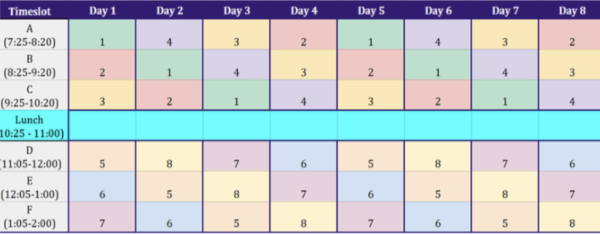
The proposed schedule has six instructional periods meeting daily, three in the morning and three in the afternoon, along with a common lunch. The schedule has 2 periods “dropping” out daily. Image from CHSN January 2026 Principal’s Newsletter.
At first glance, the proposed schedule looks complicated. However, a closer look reveals a specific pattern to keep things organized.
Unlike some rotation schedules where your last period class might suddenly appear at 7:25 a.m., this proposal uses a morning/afternoon rotation system. The morning rotation, covering periods 1-4, will only ever rotate within the 3 morning slots (A, B, C) The afternoon rotation, covering periods 5-8, will only rotate within the afternoon slots (D, E, F). Here’s the catch that seems confusing at first: there are only three time slots in the morning, but you have four morning classes. This means one class “drops” every day. The same rotation of periods will happen in the afternoon.
For example, on day 1, you might attend periods 1, 2, and 3 in the morning, while period 4 drops (you don’t have it that day). In the afternoon, you attend 5, 6, and 7, while period 8 drops. On day 2, the schedule shifts so that you attend periods 2, 3, and 4 in the morning while period 1 drops. The result? You still carry a full load of 8 courses, but you only attend 6 of them per day.
The administration’s email gives context as to another reason why the administration established to allow: “continued participation in programs such as BOCES.” Many Clarkstown students spend half their day off-campus attending Rockland BOCES, usually for technical and career education. A standard “waterfall” schedule (where any class can fall at any time) would make BOCES impossible. The drop rotation ensures that if you get to BOCES in the a.m., you will simply miss the a.m. rotation at the high school, but your afternoon academic classes will still be waiting in the p.m. rotation.
Another adjustment for students will be the length of the classes. The proposal moves us from our current shorter periods to 55-minute long classes. The district argues this allows for “deeper learning” and “extended discussions.” In a science class, this means labs aren’t a frantic rush against the bell. In English, a debate doesn’t have to be cut off just as it gets interesting. However, it can be seen as more strenuous for students. A 55-minute lecture is a lot for anyone. Teachers will likely need to adjust their teaching styles to include more breaks and different activities to keep students engaged.
The most radical and controversial change is the 10:25-11:00 a.m. slot: a 35-minute “common lunch.” Currently, lunch is fragmented, and you eat only when and if your schedule allows, often separated by friends in different grades. This new plan aims to fix all of that. The benefits of a singular lunch could be utilized for club meetings, rather than relying on the occasional activity day. It could also be used for extra help, just some time to pop into a teacher’s classroom for help without missing a different class. This will be beneficial to students taking AP and honors classes, students with a packed schedule, or students who are very involved in school activities and don’t usually have much time, even to eat. Everyone will appreciate this guaranteed break in the school day. And more importantly, everyone is free at the same time, a perfect opportunity for students to socialize.
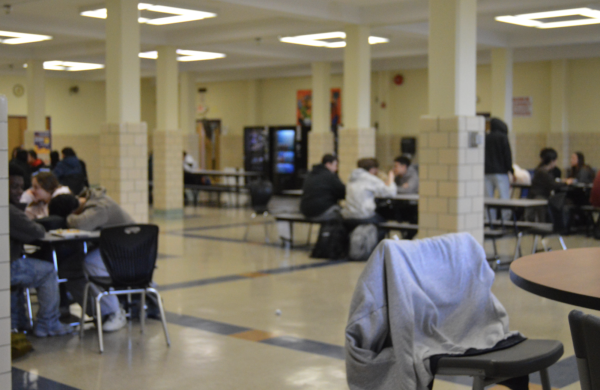
Students gather in the main cafeteria during a current lunch block. The proposed 2026-2027 schedule aims to turn this into a “common lunch,” allowing all students to socialize and meet for clubs at the same time. Credit: Photo by Hailey Goldberg
However, the logistics seem to be a question. Clarkstown North Junior Dallas Grosso brings up a great point: “We have about 1200 students, and only 2 cafeterias. The math isn’t adding up.” Without even mentioning this hurdle, how will the cafeterias and their staff manage this many students within just 35 minutes? The administration addressed this in the January principal’s newsletter. It seems the library, hallways, and additional classrooms may become designated eating or hanging-out zones to prevent overcrowding when the weather isn’t warm enough to eat outside. In addition, North is encouraging students to utilize the “Grab-and-go” lunch options, solving the cafeteria rushes that everyone hates.
This schedule change brings both pros and cons. On one hand, homework can be more easily managed, everyone gets a guaranteed lunch, and classes allow for more in-depth learning. On the other hand, the drop schedule may cause initial confusion, and longer classes might challenge student attention spans. Nonetheless, this is a time of change for North and South, and it is up to students and staff to make the most of this new schedule.